Apprentice Retention
Apprentice Dropout Rates

Created by
Ian Cooper
Why Half Our Apprentices Are Walking Out the Door Before They Finish
There is a quiet crisis building in Australian manufacturing, and it is not happening overnight. It has been developing for years, in workshops, on factory floors, and in the middle of shifts where experienced tradespeople are stretched thin and newer workers are left to figure things out largely on their own.
The numbers make it hard to look away.
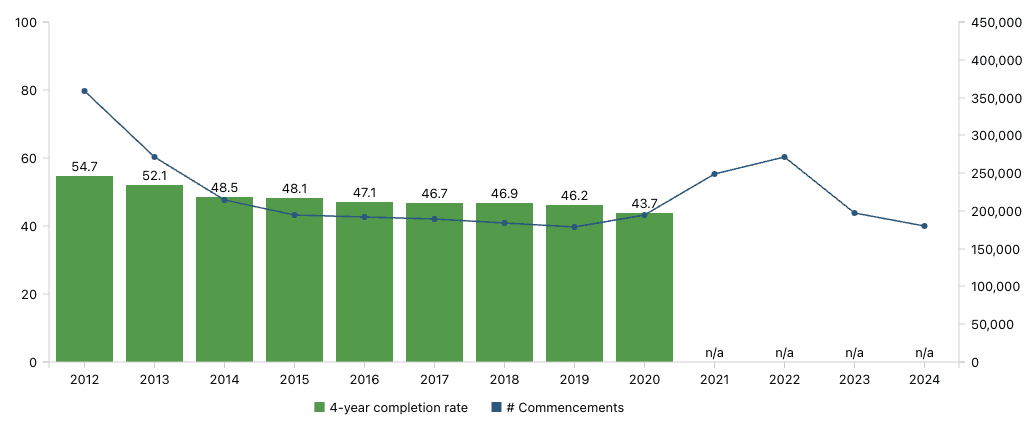
According to the National Centre for Vocational Education Research, of all the apprenticeships that began in 2020, only about 48% made it through to completion over the following four years. That means roughly one in every two apprentices who started a trade never finished it. At the same time, the total number of apprentices in Australia has fallen from a peak of around 427,000 in 2021 down to the low 220,000s by 2025. Our trade pipeline is not growing. It is shrinking, and shrinking fast.
To understand why this matters, you need to look at what trades actually contribute to this country.
What We Stand to Lose
Australian manufacturing is worth around 137 billion dollars, sitting somewhere between 5.1 and 5.9 percent of GDP. That is roughly one in every twenty dollars generated in the Australian economy coming from making things, not digging them up or selling a service. And the 880,000 people working in manufacturing today are each contributing somewhere in the vicinity of 1.5 million dollars in value to the economy. These are not small numbers.
But here is the part that should concern every manufacturer, every supervisor, and every industry body paying attention. In 1995, manufacturing employed 1.1 million Australians when the total population sat at around 18.1 million people. By 2025, the population has grown to 27.6 million, yet the manufacturing workforce has dropped to 880,000. More people in the country, fewer people building things.
And on top of that, experienced tradespeople are retiring in significant numbers. The ABS reported that 156,000 Australians aged 45 and over retired in the 2024 to 2025 financial year. Trades account for roughly 13 to 14 percent of Australian employment, so a reasonable estimate puts around 21,000 tradespeople retiring from that group alone in the past year.
Now run the numbers forward. In the first quarter of 2025, around 32,000 people began a trade apprenticeship. With the current completion rate sitting at 48 percent, by 2030 we are likely looking at fewer than 20,000 new qualified tradespeople entering the workforce from that cohort. We are replacing 21,000 retiring workers with roughly 19,800 newly qualified ones, and that assumes no further decline in completion rates.
The gap is real. And it is getting wider.
Why Are Apprentices Walking Out
There is rarely one single reason an apprentice leaves before finishing. But if you spend any time on a shop floor or talk to supervisors who have watched it happen, a few things come up again and again.
Apprentices walk into environments where experienced tradespeople are flat out. There is no time to explain, no written record of how a machine has behaved historically, no structured way to pass on the diagnostic thinking that comes from fifteen years of working with that equipment. An apprentice is expected to absorb knowledge that mostly lives inside someone else's head, and when that person is tied up dealing with three other problems at once, the apprentice is left standing there with nothing useful to work from.
That is not a criticism of experienced tradespeople. They are doing their best under real pressure. But it points to a genuine structural problem. The way knowledge moves in most manufacturing environments is still almost entirely dependent on verbal handover, memory, and whoever happens to be available. When the apprentice does not get the support they need, when they feel out of their depth week after week with no clear path forward, it becomes very easy to walk away and find something else.
Add to that the compliance and documentation side of the job. Permits, SWMS, toolbox talks, shift handovers. In many workplaces these are still paper based, inconsistent, and treated as a burden rather than a resource. An apprentice who cannot get a straight answer about why a piece of equipment is behaving a certain way, and who is also trying to navigate documentation that no one has explained properly, is an apprentice who is going to start questioning whether the whole thing is worth it.
The Knowledge Problem Is the Real Problem
It is tempting to frame apprentice dropout as a retention issue, something to be solved with better pay or more regular check ins. Those things matter, but they do not address the underlying problem.
The underlying problem is that most manufacturing environments do not have a reliable system for capturing and sharing trade knowledge. What gets recorded tends to be the bare minimum required for compliance. What does not get recorded is the good stuff, the fault finding logic, the machine quirks, the diagnostic steps that an experienced tradesperson runs through automatically because they have done it a hundred times.
When that knowledge only lives in someone's head, it cannot be shared with an apprentice efficiently. It cannot be searched when something goes wrong on night shift. It disappears entirely when that person retires or moves on.
This is where the conversation about digital reporting becomes genuinely important, not as a technology trend, but as a practical response to a real operational gap.
When tradespeople can capture reports directly from their phones, add photos, record voice notes, and link observations to specific machines through a QR code scan, that information starts to build into something useful. A new apprentice scanning a machine can see its full history. They can read how a similar fault was diagnosed six months ago. They can access structured notes from experienced tradespeople who may no longer even be on that site.
That kind of structured knowledge capture does not replace the hands on learning that trades require. But it gives apprentices something to work from. It reduces the feeling of being dropped in the deep end, and it makes experienced tradespeople more effective mentors even when they are stretched thin, because the knowledge they carry does not have to be delivered in real time from scratch every single time.
What Structured Reporting Actually Changes
The practical benefits of getting this right go well beyond apprentice support. Shift handovers become cleaner. Instead of a verbal rundown at the end of a shift that may or may not cover everything relevant, there is a structured record that the incoming crew can actually read and act on. Faults that were investigated but not resolved get carried forward clearly. Nothing important falls through the gap between shifts.
Compliance documentation becomes less of a burden when it is built into the way people already work. SWMS and permits generated through the same system that captures daily reports are more likely to reflect what is actually happening on the floor, which makes them genuinely useful rather than a box ticking exercise.
Diagnostics improve when there is a searchable record of how similar problems have been handled before. An apprentice or a junior tradesperson working through an unfamiliar fault can draw on documented history rather than starting from zero or waiting for someone more experienced to become available. AI supported diagnostic tools that draw on previous reports, equipment manuals, and internal knowledge make this even more powerful, particularly for complex or intermittent faults.
Multilingual teams, which are increasingly common in Australian manufacturing, benefit significantly when reports can be translated and accessed in a language the worker is most comfortable reading. Knowledge should not be locked away behind a language barrier.
Protecting What We Are About to Lose
There are experienced tradespeople in Australian manufacturing right now who are carrying thirty or forty years of practical knowledge. They know exactly how certain equipment behaves under different conditions. They know the shortcuts that work and the ones that only look like shortcuts. They know how to read a fault before it becomes a breakdown.
When those people retire, and they are retiring at a rate the industry cannot easily absorb, that knowledge does not have to walk out the door with them. But only if the systems are in place to capture it before they go.
That is not a complicated idea. It is just a matter of building it into the way work is reported and documented day to day, so that over time, the practical intelligence of an experienced workforce becomes part of the organisation's permanent record rather than someone's personal memory.
The apprentices coming through now are going to carry Australian manufacturing for the next three decades. The best thing the industry can do for them is build environments where knowledge is visible, documentation supports rather than frustrates, and the learning that comes from experience is actually preserved.
That is what modern reporting systems are designed to do. And that is what the industry needs, not in five years, but now.
Here is a recent podcast Co-hosted by Ian Cooper the founder of workex, highlighting some of the issues we are having in industry today.