Educational
The AI Triangle

Created by
Ian Cooper

The AI Triangle: Why You Cannot Have Capability, Compliance and Cost All at Once
Right now, every leadership team is asking the same question. Which AI model should we use? It sounds simple. You want something smart. You want it secure. And you want it affordable. B
ut the reality is you cannot maximise all three. That is where the AI Triangle comes in. Capability. Compliance. Cost. You can only truly optimise two at any one time.
Start with the real problem
Most businesses do not struggle because AI does not exist. They struggle because they pick a model without understanding the trade off they are making. Start ups and smaller manufacturers often move straight to ChatGPT. It is powerful, flexible, and produces strong reasoning, writing, and pattern recognition. It feels capable from day one. More conservative organisations lean toward Microsoft Copilot. It sits inside the Microsoft environment. It feels safer. It ticks governance boxes. Both decisions make sense. But both come with compromises. The problem is not which model is better. The problem is understanding what you are giving up.
The Three Corners of the Triangle
Let’s break it down in plain English.
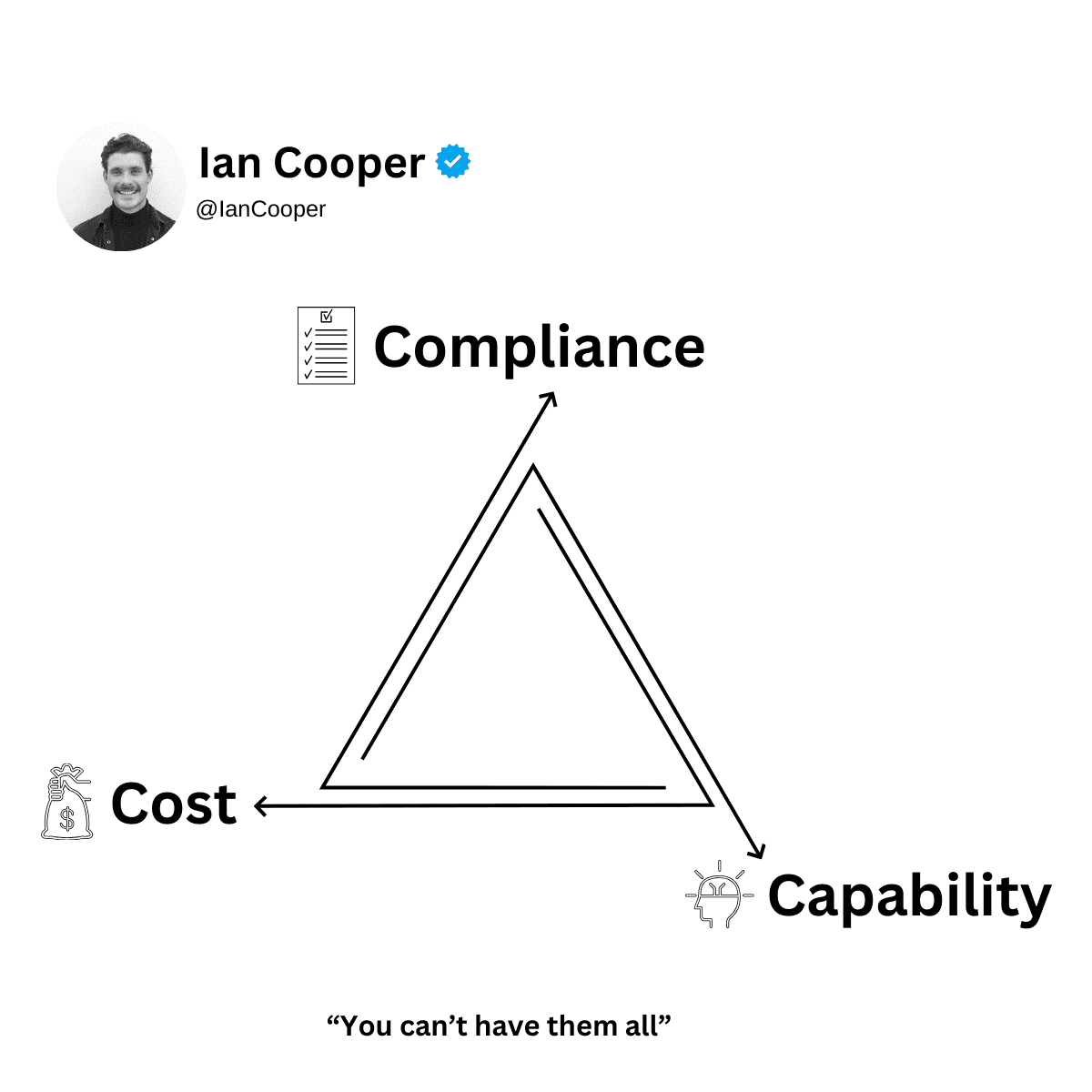
Capability. This is how smart and useful the model really is. Can it troubleshoot complex equipment issues? Can it reason through fault patterns? Can it draft clear reports? Can it identify recurring problems across data sets? In manufacturing environments, capability matters. If the model cannot reason through machine histories, interpret photos, or connect patterns in past reports, it becomes a novelty instead of a tool.
Compliance. This is about comfort and control. Where is the data stored? Is there a clear audit trail? Can you control tenancy and access? Will legal and regulators be comfortable? For large manufacturers, compliance is not optional. Audit readiness, data residency, and internal governance frameworks are real constraints.
Cost. This is not just licence fees. It includes integration work. Security reviews. Internal IT time. Ongoing management and monitoring. Sometimes the cheapest model on paper becomes the most expensive once you layer in internal controls and security architecture.
The Trade Off in Simple Terms
There are only three realistic combinations. High capability and high compliance equals high cost. High capability and low cost equals weaker compliance. High compliance and low cost equals average capability. That is the triangle. If you push hard into capability and compliance, you will pay for it. If you push into capability and cost efficiency, compliance will be thinner. If you prioritise compliance and cost control, you will likely accept a model with more limited reasoning depth. There is no perfect corner.
Why Start Ups Lean One Way and Corporates Lean Another
Smaller businesses often prioritise capability and speed. They want the smartest model available because they are trying to move fast. They accept a lighter governance layer while they validate value. Larger organisations often prioritise compliance and integration. That is why Copilot feels attractive. It sits within existing Microsoft tenancy, aligns with enterprise controls, and reduces perceived risk. But Copilot has limitations in deep reasoning and flexibility compared to frontier models. That may not matter for drafting emails. It absolutely matters if you are asking AI to reason across complex machine histories or technical documentation. This is where many manufacturing businesses misjudge the decision. They treat AI as a productivity assistant rather than a reasoning engine.
What This Means in a Manufacturing Environment
When you apply the triangle to frontline operations, the stakes become clearer. If you are using AI to analyse historical fault reports, photo evidence from breakdowns, equipment manuals, shift handovers, and safety documentation, then capability directly impacts downtime. At the same time, compliance matters because equipment history, safety records, and permits form part of your legal protection. And cost matters because margins in manufacturing are tight. This is why the decision cannot be made in isolation.
At Workex, the AI layer is not bolted on as a chatbot. It sits inside a structured reporting system where every report is linked to a specific machine via QR code, photos and notes are captured in a consistent format, audit trails are built in from the start, and knowledge accumulates over time. Because the data is structured and machine specific, the AI does not have to guess. It reasons within a controlled knowledge base. That changes the triangle dynamic. Instead of asking which public model to plug in, the smarter question becomes: How do we structure our operational data so that whichever model we use delivers maximum value within our compliance boundaries?
The Decision Point
So what combination do you pick? There is no universal answer. But there is a wrong approach. The wrong approach is choosing based on brand familiarity or fear. The right approach is deciding what role AI will play in your operation. If AI is just assisting with general writing, high compliance and moderate capability may be enough. If AI is reasoning across machine histories to reduce downtime and guide apprentices through fault finding, then capability becomes critical. Compliance must still be designed properly, but you cannot afford a shallow model. In manufacturing, weak reasoning equals slow diagnosis. Slow diagnosis equals lost production.
Moving Forward with Clarity
The AI Triangle is not about picking the cheapest or the safest option. It is about making a conscious trade off. For manufacturers serious about protecting trade knowledge and reducing confusion on the floor, the priority should be structured data first. Capture the knowledge properly. Link it to assets. Preserve it long term. Once that foundation exists, the AI model becomes a lever, not a gamble.
Workex is built around that principle. Digital reporting, QR linked machine histories, voice based knowledge capture, multilingual support, and audit ready documentation create a controlled environment where AI can reason safely and effectively. The model you choose will always sit somewhere on the triangle. The real question is whether your data and workflows are strong enough to make that choice work for you. When structured correctly, AI becomes more than a tool. It becomes a long term knowledge system that strengthens every shift, every report, and every generation of trades that follows.